

“The risk of dying early if you have bright nights goes up immensely. There have been a lot of studies on people after 6pm on devices getting artificial LED exposure. They live shorter lives. Cancer rates go up. They’re metabolically unhealthy.” - Andrew Huberman
Andrew Huberman1 was on The Diary of a CEO podcast a few days ago. It’s great to see the harmful impacts of LED lights and the benefits of sunlight starting to enter popular media. For far too long, the health story has been about diet, exercise, and supplements. A handful of strong voices have been shouting about the importance of getting the right light exposure with few people paying heed.
Huberman is now making it more mainstream. But, his solutions to mitigating the harmful impacts of LEDs and getting proper sunlight exposure are sub-par. Let me offer better ones.
If you’re on your device (phone or computer) past 6pm you count as a Night Shift Worker
You and I qualify as night shift workers, because the studies on night shift work..most of them were on how many people after 6:00 p.m. are on devices getting artificial LED exposure.. - Andrew Huberman
Huberman says most of us are night shift workers today. Who’s not on their phone at least past 6pm? So what’s his solution to combating these harmful effects of LEDs?
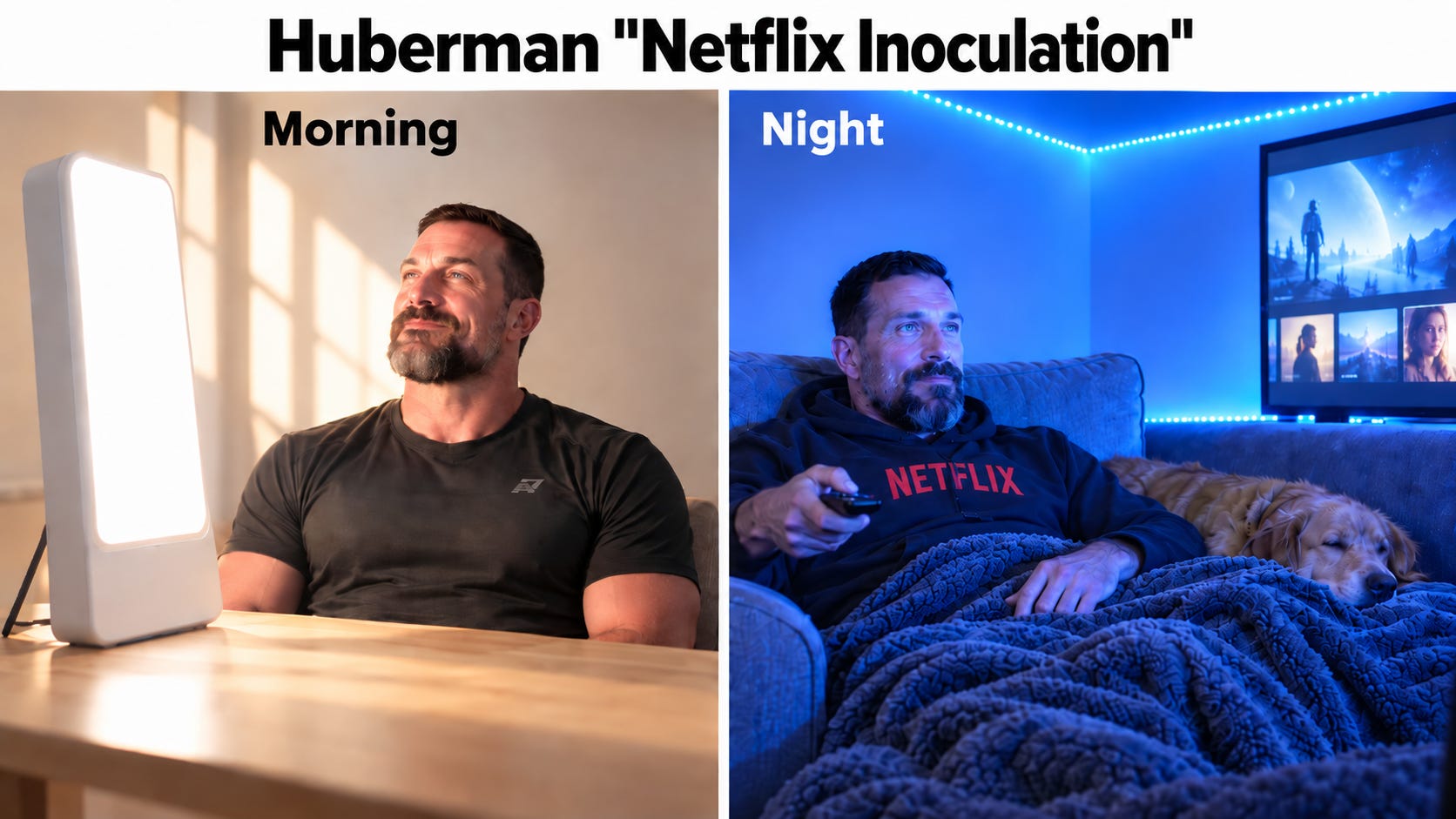
“Try and get some daylight in your eyes in the late afternoon or evening…This is your Netflix inoculation, as I call it. Like you can be on your computer at 9 or 10 at night without it damaging your melatonin levels quite as much, without it disrupting your blood glucose levels and your sleep..”
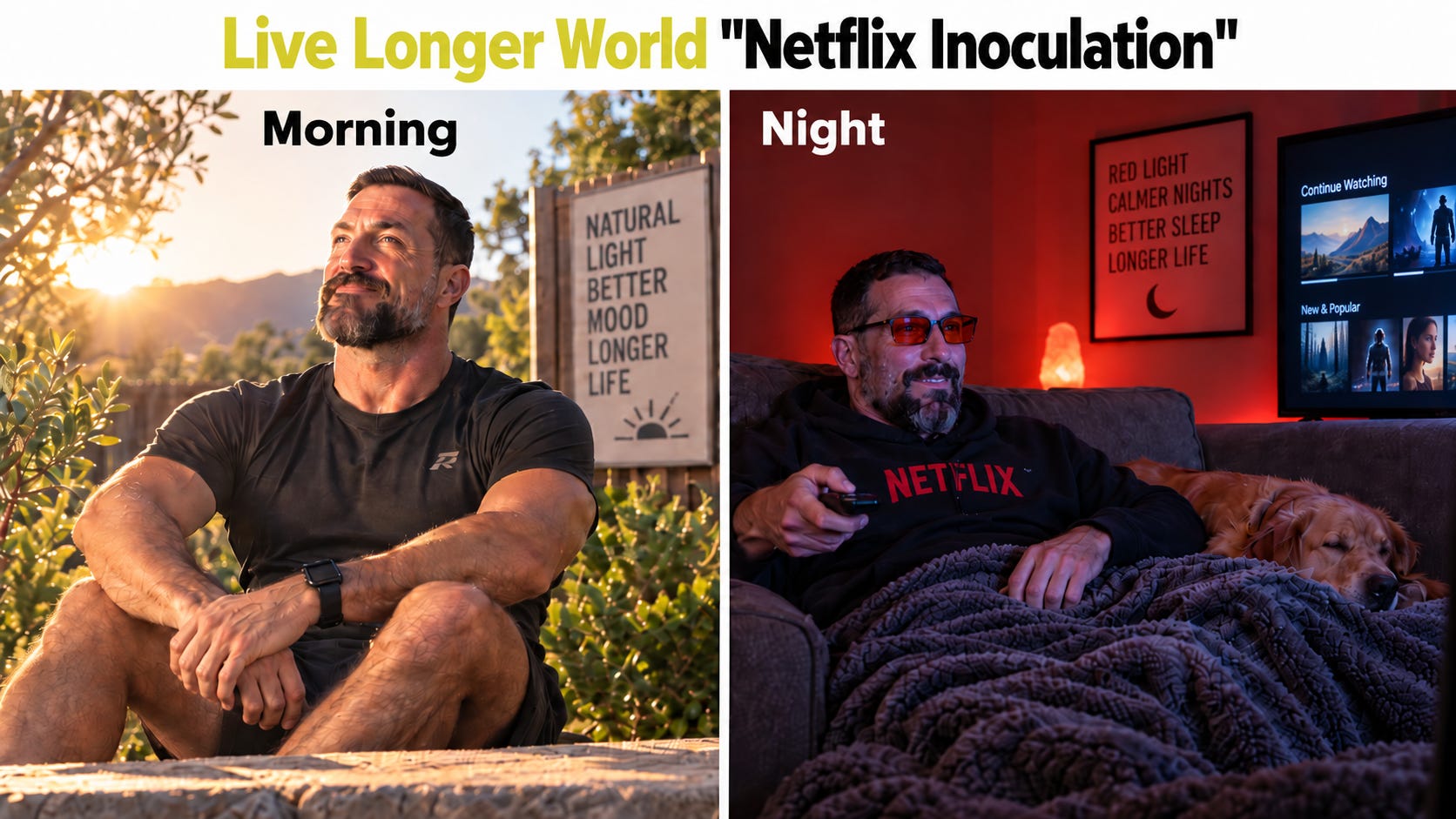
While Huberman’s suggestion is helpful, framing it as a “Netflix inoculation” is more than a little generous to his solution. What’s a more robust and better solution to make melatonin suppression at night negligible? Go for zero-blue lights at night at home and on your devices.
Blue and visible light at night is what suppresses melatonin the most, by signaling to the brain that it’s daytime.234 If you blunt melatonin with bright blue lights after sunset, you blunt not just your sleep, but also a powerful antioxidant and repair hormone. So, what should you do?
Home Lights:
Wear blue-blockers at night. I like the 4 in 1 from VivaRays. They help you block all blue at night and some blue during the day if you’re indoors under LEDs. Because isolated blue light from LEDs and screens during the day keeps you under perpetual stress.
Switch to red incandescent at night or circadian light bulbs. They go from nearly full-spectrum during the day to zero-blue at night. I like the ones from Healthy Home Shop.
Note that you don’t want the brightness on your red lights to be high at night either. Bright lights, even though they’re zero-blue, can also blunt some melatonin production. And you don’t want them to be overhead.
I keep our bedroom as dark as possible. We can detect even small specks of light, which can disrupt sleep. I use SleepOut Non-toxic curtains for our blackout curtains.
Devices:
For reading at night, I use my blue-light free Daylight computer (Code: LIVELONGERWORLD) which I love. It’s gentle on the eyes, has no blue light and is flicker-free.
Switch to only red mode for all your devices. Apple’s Night Shift Mode is a lie, it doesn’t cut out all blue. I have the 2 minute steps on how to cut all blue for your Iphone, Android, or computer here:

For my exact protocol on our zero-blue house, bedroom, and device lighting setup at night, see:

A 10,000 lux sunlamp produces blue light lux, not sunlight
Huberman says to view morning sunlight or a 10,000 lux artificial light to kickstart your circadian rhythm. I disagree. There is no replacement for sunlight. Period. A 10,000 lux artificial light like the one Bryan Johnson talks about cannot be said in the same breath as sunlight for many reasons.
Morning sunlight’s brightness is 3-5x that of a sunlight lamp. On a sunny morning, outdoor light can reach ~30,000–50,000 lux or more, while a sunlight lamp delivers its 10,000 lux only when you sit close to it. More importantly, brightness is just one piece.
Circadian rhythm stimulation and morning sunlight is not just about bright light. It’s more about the spectral composition of the light. Sunlight has red, infrared, blue, green, UVA, which is a full spectrum with each wavelength conferring unique benefits. A sunlamp? It’s blue and visible, without the infrared. It not only lacks most of the beneficial wavelengths, but is actively harmful as it delivers isolated blue without the infrared, which spikes your cortisol.
Even for those who wake up before sunrise, a 10,000 lux lamp is sub-optimal. A better solution for them is:
Avoid blue lights till dawn / sunrise. Only use red lights. Go see the sun with naked eyes at sunrise.
If you absolutely cannot avoid blue lights till sunrise, use a 10,000 lux lamp + an infrared or incandescent lamp. You want to combine the blue in the sunlamp with infrared. Sunrise is dominant in infrared, and in nature you never find blue without infrared.
See the sun as soon as it’s out. Do not skip on this.
I too used to think I can get my morning sun from a sunlamp, until I learned how stupid I was:

Morning sunlight is not a full circadian protocol. It’s just one piece.
Huberman has popularized the idea of getting morning sunlight within 30-60 minutes of waking up for a healthy circadian rhythm. This is incomplete advice for 2 main reasons:
You do not want to wait 30-60 minutes to get morning sunlight. You want to get it right upon waking up to kickstart your circadian rhythm. Waiting one hour can delay your body clock, and the effect of light on circadian rhythm is typically strongest upon waking. Additionally, if you wait one hour to get morning sunlight, you are likely exposing yourself to blue-rich LEDs with no infrared for that hour. LEDs have no infrared, whereas sunlight is full of infrared in the mornings. This infrared is charging your mitochondria and boosting your metabolism. In contrast, with blue LEDs, you spike your cortisol without any of the regenerating benefits of infrared.
Ideally, you want to wake up with dawn or sunrise: The spectral composition of sunrise makes it a potent stimulator of your circadian rhythm.5
Morning sunlight is not a full circadian protocol. It’s just one piece. Circadian rhythm is not just about morning sunlight. Light exposure throughout the day, when we eat, when we exercise, and how much light we get at night, all help tell the body what time of day it is. Huberman talks about the SCN, the master clock in the brain, which is primarily stimulated by light. But we also have clocks in our peripheral tissues, including liver, pancreas, muscle and adipose tissue. These clocks respond to signals like food timing and activity. The SCN and peripheral clocks communicate with each other, and it’s best for all the clocks to be telling roughly the same time. If morning sunlight tells our brain, “It’s daytime,” but we eat a big meal at midnight under bright LEDs, different parts of our body are getting conflicting time signals. That’s circadian misalignment. Circadian health isn’t just “get morning sun.” It means aligning light, food, activity, and sleep with the natural light-dark cycle. Improper circadian rhythm alignment (yes just the misalignment part, not lack of morning sunlight) is also linked to cancer.
For the full sunrise to bedtime protocol I follow for proper circadian rhythm alignment see:

What are the key takeaways? See the sunrise or morning sun right upon waking. Get as much sunlight during the day as you can. If indoors under blue-rich LEDs during the day, change your lighting to mimic nature a little more. Get evening sun or watch the sunset. Finish dinner by sunset. And go for zero-blue lights at night.
Live Longer World’s “Netflix Inoculation” protects your melatonin, circadian health, and sleep. Huberman’s “Netflix Inoculation” has some side effects.
Follow me on X @aasthajs & Instagram @aasthajs as I parse through the snake-oil in longevity. If my work is useful, become a premium subscriber.
You can see all the sleep and lighting products I use at healthstacked.com/aasthajs
Related Posts:


Andrew Huberman is a tenured associate professor of neurobiology and ophthalmology at Stanford University School of Medicine and host of the Huberman Lab podcast,
https://pmc.ncbi.nlm.nih.gov/articles/PMC2905913/
https://pubmed.ncbi.nlm.nih.gov/40430143/
This is because of melanopsin, a light-sensing pigment in our eyes. Melanopsin is most sensitive at 480 nanometers, the blue of a midday sky. When blue light hits our eyes and skin, it sends a signal to the master clock in our brain that it’s daytime and it should shut down melatonin production.
https://pubmed.ncbi.nlm.nih.gov/32084404/