

Hi, I’m Aastha and thanks for joining Live Longer World as I uncover practical solutions to combat toxins in our modern environment, and interview frontier longevity scientists.
On my health stack, you can see my exact collection of non-toxic health products I use (9 categories including sleep, fitness, clean water, lighting, air quality, non-toxic kitchen). Follow me on X @aasthajs & Instagram @aasthajs for more.
Dermatologists have spent decades telling us to avoid the sun. Wear sunscreen. Cover up. The fear is skin cancer. But one of the most thorough studies ever conducted on sun exposure and mortality found the opposite. Women who got the most sun lived the longest. Women who avoided the sun died at the same rate as smokers. And the most surprising finding of all? The women who lived the longest in the entire 20-year study1 got skin cancer AND were most sun-exposed.
And it wasn’t just about living longer. The study showed that women who got more sunlight were protected from:
Cardiovascular disease
Cancer (including skin cancer!)
Type 2 diabetes
Venous blood clots
Death from all causes
And the more the sun, the better the outcomes. In this post, I break down the study and what it means for how you think about the sun.
Basics of the study:
Researchers recruited 29,518 Swedish women between 25 and 64 years of age starting in 1990. They asked four simple questions about sun exposure:
Do you sunbathe during the summer?
Do you sunbathe during winter holidays?
Do you use tanning beds?
Do you go abroad on holiday to swim and sunbathe?
No to everything = low sun exposure. Yes to one or two = moderate. Yes to three or four = high. They also recorded smoking status, exercise habits, BMI, education level, marital status, disposable income, and whether the women were on medication for diabetes, blood clotting, or cardiovascular disease, all of which were used to adjust the results. Then they followed these women for 20 years and tracked what happened.
Results: Risk of disease & death increased by avoiding the sun
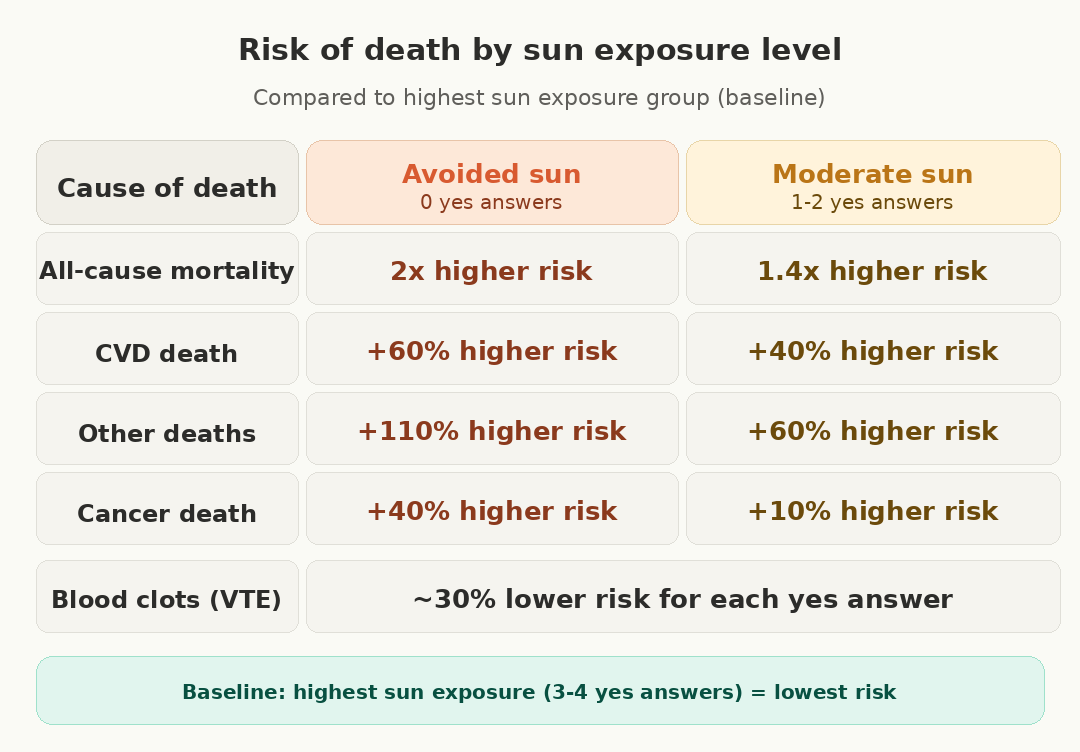
Not getting sun was as dangerous as smoking. Nonsmokers who avoided sun exposure had a life expectancy similar to smokers who got the most sun. Even among smokers, those around age 60 who actively sought the sun lived ~2 years longer than smokers who avoided it.
Heart disease: The highest sun exposure group had ~60% lower risk of cardiovascular death.
Cancer: The highest sun exposure group had ~40% lower risk of cancer death, including melanoma. In fact, women with the most sun exposure who developed non-melanoma skin cancer had the lowest mortality of anyone in the entire 20-year study. Lower than cancer-free women. Lower than every other group. More on skin cancer and melanoma findings below.
Melanoma: Melanoma incidence was slightly higher in the high sun exposure group (0.81% vs 1.1%), but the increase wasn't statistically significant. And when they did get melanoma, their risk of dying was essentially the same as sun avoiders who never got cancer at all. Meanwhile, sun avoiders who got melanoma had 4x the risk of death. And within the melanoma group specifically, sun avoiders had 8x the death rate of sun-seekers.
Diabetes: Women who avoided the sun were at nearly 2.5x the risk of type 2 diabetes compared to those with the highest sun exposure. The relationship was dose-dependent: moderate sun exposure carried 47% higher risk, and low sun exposure carried 147% higher risk. The effect was even more dramatic in normal-weight women, where sun avoiders had nearly 4x the diabetes risk.2
Other non-cancer deaths: The highest sun exposure group had over double (110%) the reduction in non-cancer, non-cardiovascular death (things like diabetes, multiple sclerosis, pulmonary diseases). Combined with the cardiovascular disease reduction, this is where the biggest increase in lifespan came from.
Dying from anything: Women who avoided the sun had double the risk of death over the next 20 years compared to those with the highest sun exposure. This translated to 0.6 to 2.1 fewer years of life for sun avoiders.
Blood clots: For every “yes” answer to sun exposure, women were at ~30% lower risk of venous thromboembolism. Blood clot risk was also 50% higher in winter compared to summer.
But is it really the sun? You might wonder: do sun-seekers just live longer because they're wealthier, more active, and healthier to begin with? The researchers tested this. They adjusted for age, smoking, education, marital status, income, pre-existing conditions, BMI and physical exercise. The results held. The survival benefit of sun exposure wasn't explained by lifestyle differences.
This study is not a one-off. A 2024 analysis3 of 376,000 UK Biobank participants found the same pattern: higher UV exposure was associated with lower all-cause, cardiovascular, and cancer mortality. A separate Swedish cohort study4 of women followed for three decades found sunbathing vacations were linked to 30% lower risk of death. The data pointing to sun exposure as protective against the leading causes of death is consistent across multiple large cohorts and countries.
But what about skin cancer risk?
Here's where it gets really counterintuitive. The women who lived the longest in the entire 20-year study weren't the ones who avoided skin cancer. They were the ones who got skin cancer and had the most sun exposure. They outlived everyone, including cancer-free women.
I couldn't believe this when I first saw it. For paid subscribers, I break down exactly what's going on:
How women with skin cancer outlived every other group in the study, including women who never got cancer.
The 8x death gap: why getting melanoma while avoiding the sun was the deadliest combination in the study, while getting melanoma with high sun exposure barely affected mortality.
The vitamin D connection: why the same cancer can kill one woman and barely affect another.
What no one tells you about the sun vs. skin cancer tradeoff: the risk of dying from skin cancer vs. the risk of dying from avoiding the sun.
