

Your computer screen is blue because your employer does not want you snoozing.
Glen Jeffery is a leading mitochondria and light scientist at UCL and he explains that blue light raises cortisol and keeps us stimulated.
“It’s stimulating. It produces a bit more cortisol. You’re a bit more stressed. It’s very clear.”
So, the blue light from computer screens ensures we don’t fall asleep at our desks.
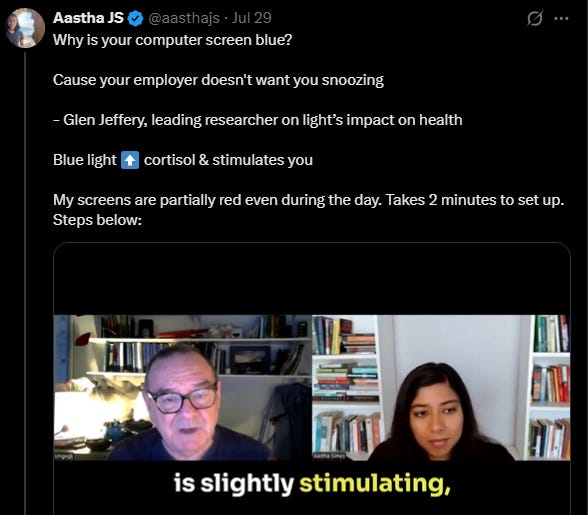
(To watch the full 22 second clip, see X or Insta.)
While this blue from screens may keep us from falling asleep, it comes with significant health costs, not just at night.
The misleading half truth that blue light during the day is good for you
Blue light during the day stimulates you. It keeps you alert, and it spikes your cortisol so you can remain focused. This has led many health influencers to conclude that “At night blue light is bad for you, but blue light during the day is not bad and that you actually need blue light during the day to be alert. Hence the blue in screens and LED lighting during the day is good for you.”
This is a very misleading half-truth.
It is true that you want blue light during the day. But you do not want the blue light that you get from computer screens, LEDs, or indoor lighting in our homes and offices. The blue light that comes from devices and bulbs (both LED lighting) is very different from the blue light you get in nature.
In nature you do not get blue light in isolation. In LED screens, you do. The blue in sunlight is at its peak during the day, but even then it makes up 25% of sunlight. 50% or greater is red and near infrared.
Your biology evolved under blue light from the sun, not from LED lighting. LED lighting is the tobacco of today’s world. We’re going to soon wake up to the health damage being done by them in the name of energy efficiency.
Blue Light from LEDs vs. Sunlight
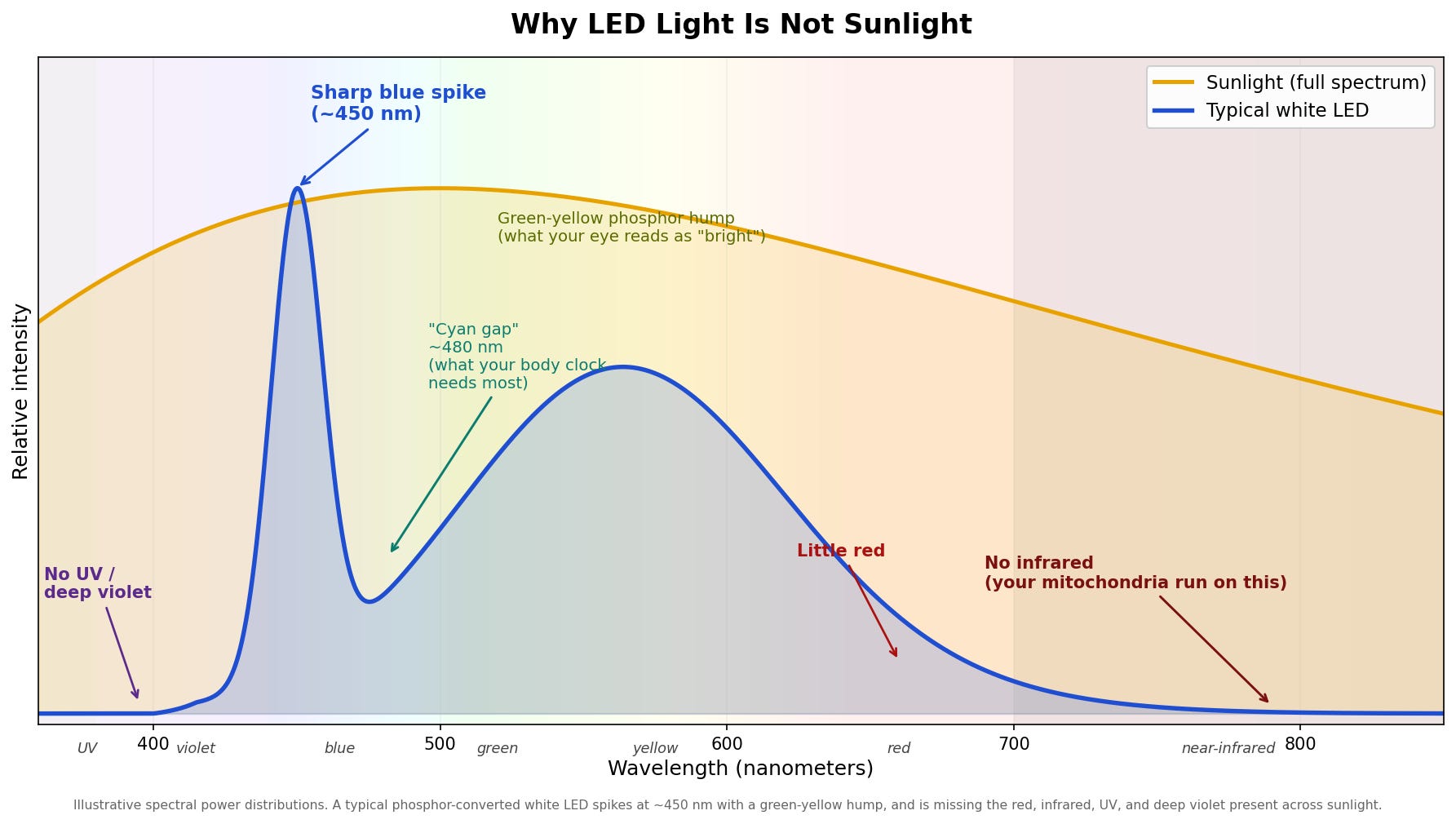
The image above shows how the light spectrum differs between LED lighting and sunlight.
Some key differences before I discuss the health implications:
LED bulbs spike in 450nm blue, a particular blue wavelength. The sun’s spectrum has no spikes. It is smooth and continuous, across the whole range of blue wavelengths. In sunlight, blue is also surrounded by other wavelengths, UV and predominantly red, infrared, and near-infrared.
LED bulbs don’t even have the right blue we need to stimulate our circadian clock! They have a gap in 480nm blue which is what is the most potent stimulator of melanopsin, the photopigment in your eyes1 that reads light levels and tells your brain’s master clock what time of day it is. Melanopsin peaks around 480nm, and that signal drives alertness, melatonin timing, and cortisol.
LED bulbs are dominant in blue with some green, and yellow wavelengths (400nm to 700nm), all in the visible spectral range. They have little to no red and infrared. Sunlight on the other hand is rich in wavelengths all the way from UV to near infrared. In fact, sunlight’s spectrum is ~50% red and infrared at any point in the day. This difference is not minor, it has significant health consequences.
Sunlight’s brightness is 100,000 lux. Contrast this with a typical office lit by LED bulbs which is only 300-500 lux. Even if you stack several bulbs, you cannot replicate the brightness of sunlight. This brightness is key for proper stimulation of circadian rhythm.
Summary: Under LED lighting you only get blue light, particularly in the 450nm range. Under the sun, you get blue light with plenty of infrared and near-infrared. And the blue in the sun does not only spike at one wavelength. It is continuous, providing energy from all wavelengths our body needs.
These differences are not trivial. They have massively different implications for our health and energy.
The blue in LEDs and computer screens keeps you constantly agitated:
During the day, blue light stimulates you to go work. It does raise cortisol. In sunlight, the cortisol spiking effects of blue are counterbalanced by the calming effects of red and infrared2. This way you’re not under perpetual stress mode. You get the alertness and the calmness together in sunlight.
This is in stark contrast to the lighting environment of a typical office worker. We sit under blue-rich LED lights staring at blue computer screens. Our windows block most red, infrared and UV. They predominantly allow blue light to come in. As a result, the office is only surrounded by blue light. There is no infrared. Merely 100-150 years ago when most of us were farmers, we spent almost all our waking hours outdoors. Being in isolated artificial blue lighting is a modern day problem.
What happens when you get blue in isolation? You’re constantly agitated and stimulated. You’re under a constant low-level stress. This is not how it’s meant to be. We’re meant to get the calm effects of red and infrared to balance this cortisol spike.
In a recent study3, office workers were subjected to daylight vs. artificial LED light. They controlled the brightness to be the same. Under daylight, the workers had better cognition and low stress. Under blue-dominant artificial light, they had higher sympathetic arousal (nervous system preparing for action, stress or danger). This implies that it’s not the brightness, but the fact that the red and infrared in sunlight counterbalances the stress. In contrast, under LED lighting and screens, your nervous system is in constant arousal mode, and cognition is worse.
This is one reason why office environments can be so stress inducing. It’s not only your boss ;)
This is why when I work in front of my computer screen indoors, I use my daytime blue-blocker from VivaRays (code LIVELONGERWORLD for 10% off) to partially block some of the blue. I do not want isolated blue light from computer screens stressing me out.
LED lighting flickers and causes eye strain:
The blue light isolation is not the only reason LED lighting is stressful. LED bulbs and computer screens when dimmed also flicker constantly. Screens will fake low brightness by rapidly pulsing on and off 100 to 120 times a second. Even though our naked eye cannot detect it, the flicker makes our pupils constantly dilate and constrict. It can be detected by our brain and visual system leading to eye strain and headaches.
There are easy fixes to remove this flicker from your computer and phone screens. See:

When you get no infrared from the sun, energy production and metabolism falters
The big problem with blue-rich LED lighting is that they strip out all the red and infrared. In sunlight, you ALWAYS have 50-55% infrared at any time of the day. Our mitochondria and metabolism evolved to absorb infrared and near-infrared light4 and use it to produce energy. When we avoid the sun, live under LED lighting and blue screens, we starve the mitochondria of an essential nutrient, resulting in altered energy production which can manifest as disease. Mitochondrial dysfunction is linked to practically every chronic disease. Needless to say, the health of our mitochondria is key.

So what’s the solution to mitigating isolated blue light?
I’ll discuss how to set up your office environment, home environment, and your screens to mitigate this effect. I’ll include tips for people who work in an office where they cannot control their lighting. There are still some easy steps you can take. Many of these include tips for everyone for general circadian health to mitigate the effects of isolated blue light.
Office environment where you can control your lighting:
Set up an outside desk if you can: No indoor lighting beats sunlight. You can utilize the shade, you do not have to get fried. You still get plenty more infrared in the shade than you would sitting indoors. I have an outdoor shaded desk setup and spend 6-8 hours in the sun everyday. When it’s too hot, I come inside.
Circadian lighting: Circadian lights are closer to full-spectrum including infrared during the day and zero-blue at night. I like the ones from Healthy Home Shop (code LIVELONGERWORLD for 10% off). This way you’re not getting isolated blue light during the day. And the same bulbs turn to zero blue at night.
Open your windows and let sunlight come in. Window glasses naturally block UV and infrared, so you’re only getting blue light, which adds to the isolated blue light problem. Even if you’re not sitting directly in front of the window, sunlight photons are streaming in and benefiting you.
Add a circadian and red lamp to your desk. Circadian lighting is good for lighting the whole room. However, it’s often not a powerful enough light stimuli to most potently activate your circadian clocks. They lack the brightness you need unless you stack them up. Chroma makes circadian lighting and red light lamps especially for the office worker (code LIVELONGERWORLD for 10% off). You can use both on your desk to get the circadian and infrared boost. If you work indoors, this is one of the best substitutes you have for sunlight.
VivaRays Blue light blocking glasses: It’s a myth that you only need blue-blockers at night. If you are working indoors under LED lighting in front of a blue computer screen, you want to block some of this blue to not damage your eyes. I love the 4-in-1 from VivaRays (code LIVELONGERWORLD for 10% off), and use their daytime blue-blockers when working in front of my screen indoors, every day! Their 4-in-1 lets you block out partial blue during the day, and full blue at night. They are also the only ones that make prescription glasses that allow UV to come in. UV to the eyes is key for regulation of dopamine, mood etc. When outside, use their UV glasses (if you have prescription) and when indoors use their blue-blockers.
Use a zero-blue tablet for reading and other tasks. I love my Daylight Computer - zero-blue and zero flicker screens! (Use my link for $25 off)
Step outside for plenty of sun snacks. You want to get sunlight throughout the day to let your body and circadian clocks know what time of day it is. Merely morning sunlight does not do it. Our clocks don’t just start in the morning and run by themselves, they need light signals throughout the day to maintain proper circadian functioning. Step outside and view the sun (without sunglasses, prescription glasses, or sunscreen) during your bathroom, water, and lunch breaks. Even 1-2 minutes of sun snacks throughout the day helps.
Office environment where you cannot control the main lighting:
Even if you can’t control the main lighting, the last 4 points above can be utilized effectively to mitigate isolated blue light.
Add a circadian and red lamp to your desk like the ones from Chroma
VivaRays Blue light blocking glasses
Zero-blue tablet like Daylight Computer
Get plenty of Sun snacks
Strip out blue light from Screens:
I always keep my devices on partial red mode, even during the day. I do not want isolated blue light stressing me out. At night, my devices are on pure red, zero blue light mode. Blue light at night particularly disrupts melatonin and repair processes in the body. Wear blue light blockers if you don’t turn your screens red during the day.
It takes 5 minutes to set your devices to red mode:

And again, this is how you mitigate flicker:
Home environment:
Be outside as much as you can: If you spend most of your time home, be outside as much as you can. Again, utilize the shade when you need to.
Leave doors and windows open to allow sunlight and fresh air to come in.
Replace your lights with circadian lighting: LED bulbs are the tobacco of today’s world. Switching to circadian lighting is one of the easiest, set-it-and-forget-it, and low-cost health interventions you can make. Again, Healthy Home Shop and Chroma are my go-tos.
No need to use LED bulbs during the day (and especially not at night), they’re not benefiting you. Let natural light come in or use circadian lighting or incandescent bulbs.
Have red lights only after dark: Use zero blue lights after dark. We use red incandescent bulbs only. If you get the circadian lighting from Healthy Home Shop, the same bulb goes from full-spectrum during the day to zero-blue at night, which many people find convenient. Blue at night is particularly harmful. It suppresses melatonin which is not a sleep hormone, but one of the most powerful antioxidants your body has. Suppress melatonin with blue light, and you suppress repair processes while you sleep.

Summary of Products I use to cut out isolated blue light:
VivaRays 4 in 1 Blue Blockers and UV transmitters: VivaRays makes 3 in 1 blue blockers that you can easily switch from day to evening to night.
Use my link https://vivarays.com/livelongerworld or discount code LIVELONGERWORLD for 10% off.
Healthy Home Shop Circadian Bulbs: The Circadian bulbs have 3 light settings that easily switch spectrum from daylight (full-spectrum) to evening to night (blue-light free). This is exactly what you want for mimicking the sun’s wavelengths indoors. And no WiFi required.
Use my link https://thehealthyhome.shop/livelongerworld for 10% off.
Daylight Computer No-blue screen: I love reading on my Daylight! They have zero blue light and are flicker-free. It’s such a peaceful reading experience, without causing you any eye strain.
Use my link https://buy.daylightcomputer.com/livelongerworld for $25 off.
Chroma Circadian-Aligned Desk Lamp: The Sky portal desk lamp is a great circadian lamp for your workspace. It delivers bright light during the day, and red light as evening sets in.
Use my link https://getchroma.co/photonsfromaastha and code LIVELONGERWORLD for 10% off.
Iris Software: It removes blue light and flicker from computer screens. This is what I use to keep my screens on partial red mode even during the day.
Use my link https://iristech.co/?ap_id=livelongerworld for 1 month free.
For all the Lighting & EMF products I use, see my health stack
For the full collection of Lighting & EMF products I’ve curated, see Health Stacked
Follow me on X @aasthajs & Instagram @aasthajs as I parse through the snake-oil in longevity. If my work is useful, become a premium subscriber and purchase through my affiliate links of products I use and love.
Browse my health stack across 12+ categories (sleep, fitness, non-toxic kitchen, clean water, skincare, diagnostics, lighting).
For the full collection of 500+ health products curated by me, see Health Stacked.
Related Posts:



Intrinsically photosensitive retinal ganglion cells (ipRGCs)
https://pubmed.ncbi.nlm.nih.gov/32723201/
https://www.sciencedirect.com/science/article/abs/pii/S2352710226012714
In our mitochondria sits an enzyme called cytochrome c oxidase. It's the final step in the chain that produces ATP, the energy our cells run on. Red and near-infrared light penetrate our tissue, reach this enzyme, and boost its output. More light, more ATP. This is just one mechanism. Emerging research shows that infrared light also structures the water around mitochondria.