

For a million years, humans used firelight at night. 145 years ago, we introduced incandescent bulbs. In 15 short years, LEDs went from nothing to half of all the lighting in American homes. These LED bulbs1 have introduced blue rich light without any of the beneficial infrared. What is the health impact of this, especially at night given we evolved under no blue lights at night for millions of years?
This is Part 2 on my non-toxic bedroom environment where I discuss my lighting setup at night. In Part 1, I discussed how your mattress emits toxic fumes while you sleep, and why I only use natural organic non-toxic mattresses and bedding.

How I Switch my Lighting at Night to Mimic Nature:
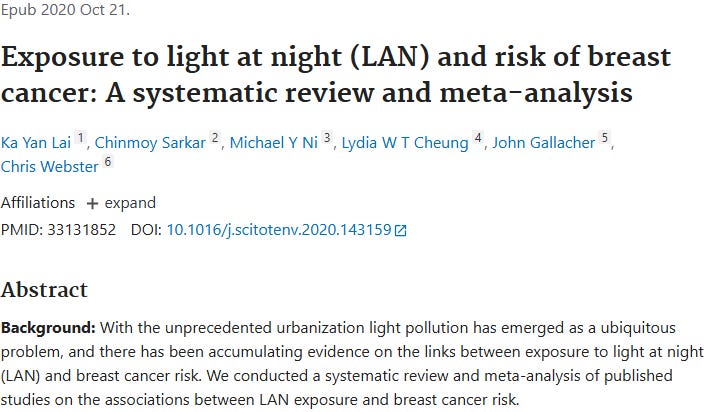
In nature, it’s dark after sunset. Darkness is a signal to our bodies to start winding down and begin repair processes. Our modern lives with electricity and blue-rich LED bulbs make this impossible. Blue light at night is linked to cancer (especially breast2 and prostate3 cancer), diabetes4 and heart disease.5

Even during the day, LED bulbs keep us in perpetual stress mode. (See below post on how office workers can reduce stress by mitigating isolated blue light from LEDs and screens in a home or non-home office setting.)

Not to mention that LED lighting flickers constantly, giving you eye strain and headaches.
Blue-rich lights that stimulate you and inhibit repair processes by blocking melatonin6 are the exact opposite of what you want at night. Here is how I switch our home, bedroom, and device lighting as evening dawns and sunset begins:
Home Lighting:
We use red incandescent bulbs at night. They emit zero-blue. I got some from Amazon but sadly they’re going out of stock since the fatal ban on incandescents.
I recommend circadian lighting from Healthy Home Shop. The same bulbs switch from full-spectrum during the day to zero blue at night. They mimic nature much better than any traditional LED. No WiFi needed to work them. (10% off with link)
After sunset, I use blue-light blockers from VivaRays, (Code: LIVELONGERWORLD). VivaRays makes 3-in-1 blue light blockers to block different intensities of blue over the course of the day. Isolated blue light (without the infrared) from LEDs and screens during the day raises your cortisol. So, if you’re going to be working indoors in front of screens & LED bulbs, you want to wear their yellow blue-light blockers (stops some blue) during the day. And then you switch to the red ones at night, which block all blue.
I absolutely hate the bright blue light in all refrigerators. Especially when you’re putting dinner away in the fridge, the last thing you want is being blasted by blue light before bed. There is also research that blue light at night can increase appetite and sugar cravings. So the last thing you want is being bombarded with blue light from the fridge and tempted to pull out that ice-cream! I finally found a way. It’s a neat set it and forget it $5 hack.

Bedroom Lighting:
I keep our bedroom as dark as possible. We can detect even small specks of light, which can disrupt sleep. I use SleepOut Non-toxic curtains for our blackout curtains. Most blackout curtains are made of polyvinyl chloride (PVC) or synthetic materials like polyester which release toxic fumes called volatile organic compounds (VOCs) and formaldehyde (a carcinogen!) over the life of the curtain. VOC releases get magnified when sunlight hits the curtains through the window. So, during the day, these VOCs keep infesting your bedroom and it’s what you breathe in while you sleep. Jeez! (Yes, these are the same VOCs we encountered in mattresses).
SleepOut uses only non-toxic materials and the best part is that they have a portable curtain too, so you can easily carry it with you when traveling.
I use an organic cotton or silk sleep eye mask. Even low-level light can disrupt sleep.
Device lighting:
For reading at night, I use my blue-light free Daylight computer (Code: LIVELONGERWORLD) which I love. It’s gentle on the eyes, has no blue light and is flicker-free.
When using devices at night, turn them all on zero blue or red light mode. Apple’s Night shift mode is a lie. It does not cut out all blue light. To do so, here are the steps for Iphone, Android, and your computer.
When working on your devices at night, if you don’t want them on full red mode, or if you’re working under lights that are not zero-blue, use blue-light blockers, like the ones I have from VivaRays. (Code: LIVELONGERWORLD)

We spend many hours of our life sleeping, and it’s also the time when the body is repairing. I sincerely believe that we should create an environment to allow for proper rest and restoration.
In the next post, I’ll cover how I change our house EMF exposure at night.
You can see all the sleep and health products we use at healthstacked.com/aasthajs
Follow me on X @aasthajs & Instagram @aasthajs. If my work is useful, become a premium subscriber.
Related Posts / Podcasts:

I’m talking about traditional LED bulbs that spike in blue and are dominant in primarily visible light, with negligible red and infrared. These are the LED bulbs you find in most homes and public spaces. You can engineer LED bulbs to have more red and infrared and that’s the circadian bulbs I recommend.
https://pubmed.ncbi.nlm.nih.gov/29768068/
https://pubmed.ncbi.nlm.nih.gov/29687979/
https://pubmed.ncbi.nlm.nih.gov/31704511/
https://jamanetwork.com/journals/jamanetworkopen/fullarticle/2840489?
Melatonin is not a sleep hormone; it is one of the most potent antioxidants and defense systems we have. Melatonin helps in cleaning up cancer cells, in reducing deuterium, and in repair processes. So, blocking melatonin release at night with blue rich lights can have serious ramifications.