

Most people sleep on sheets of plastic every night, breathe in toxic fumes, and are surrounded by electrical signals that disrupt the body’s repair.
I did it for 10+ years. We assume we’re getting restorative sleep while never creating an environment designed to repair.
Much of sleep advice focuses on dinner timing, dinner composition, and activities to do before bed like a warm shower or cutting out social media. I used to practice some of these for years, with little improvement to my sleep, but nothing significant.
What drastically improved my sleep was making my bedroom environment less toxic, getting more sunlight during the day, and eating dinner by sunset.
Sleep is when our body is repairing and we must give it a proper chance to do so by mitigating the effects of toxins. Our sleep environment should be as pure as possible, and devoid of modern day toxins like blue lights, EMF, polyester bedding, noise, excess CO2, dirty air, and other such toxins.
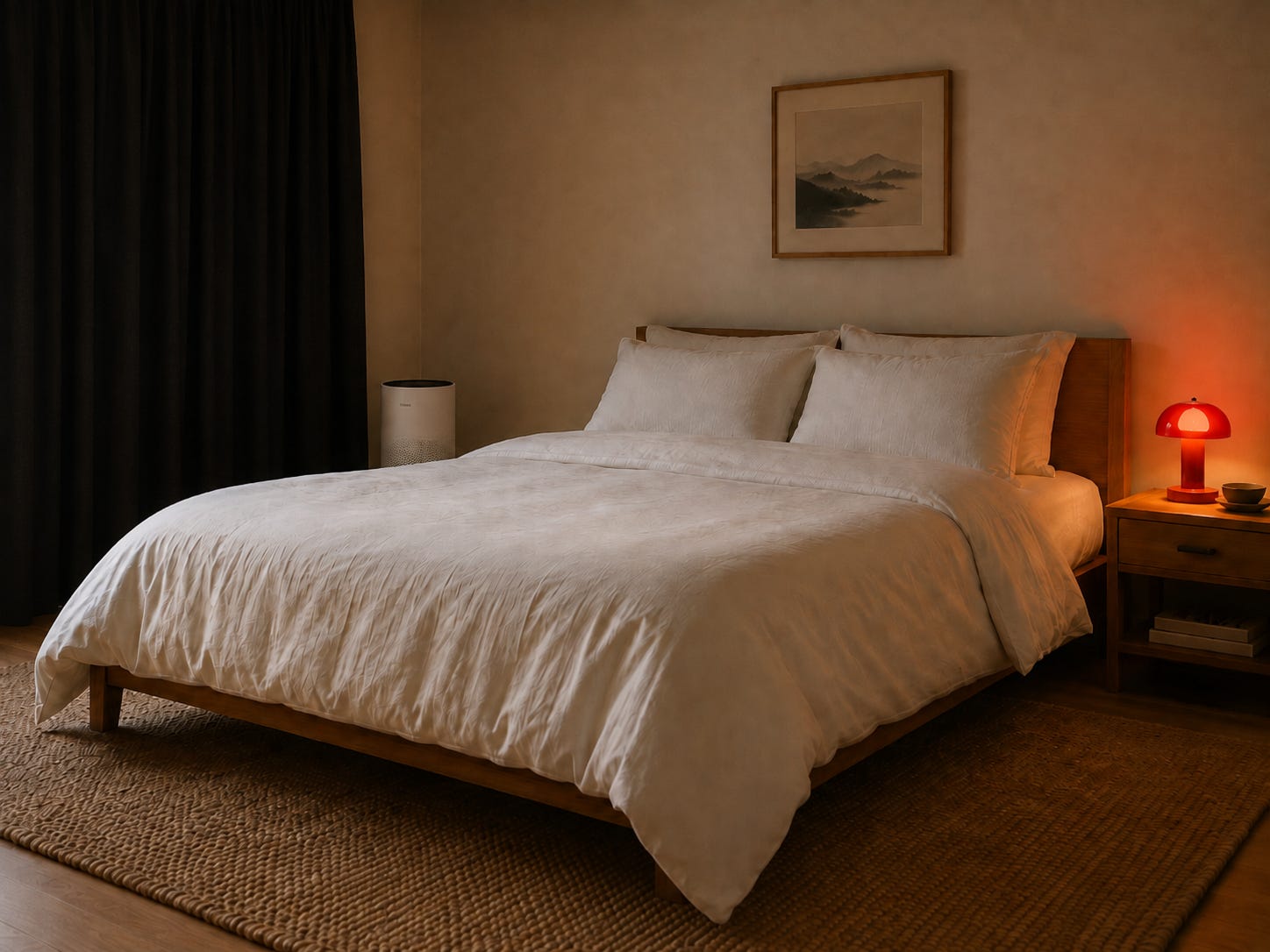
Below I detail my exact non-toxic bedroom set-up in 3 parts.
Part 1: Mattress, Bedding, Pillow (this post)
Part 2: My Zero-Blue Lighting Set-up at Night and Low EMF bedroom
Part 3: Maintaining good Bedroom Air Quality while you sleep
Mattresses were designed to pass a fire test, not provide restorative sleep
Most mattresses are toxic. I had no idea about this till last year. Nothing in a mattress is chosen for how it interacts with a human body for 7+ hours a night. Every layer is chosen to pass a fire test, survive shipping compressed in a box, and hit a price point.
Mattresses are made of a material called polyurethane foam and adhesives (glue that holds every layer together). These emit Volatile organic compounds (VOCs) that are the chemical smell from a new mattress and are toxic fumes to inhale. VOCs can take a month or more to dissipate. At high levels they cause headaches, eye and throat irritation, and dizziness, and some of them, like formaldehyde and benzene, are carcinogens. The crazy part is that the VOC emissions test for every mattress is run cold. However, when you sleep on these mattresses, body heat multiplies the toxic effect and increases the emission rate by 2.5x or more!1
Then you have the bigger problem which is chemicals that don’t evaporate away so easily called semi-volatile organic compounds (SVOCs). In a mattress, these include phthalates, flame retardants, plasticizers and stain repellents. Phthalates are endocrine disruptors, meaning they interfere with hormone signaling, and are linked to reproductive and developmental effects. In some small studies, flame retardants have been associated with lower IQ in children. PFAS are “forever chemicals” that build up in the body and don't break down.
So, unlike VOCs, these SVOCs don't evaporate away. They keep migrating into dust that you breathe and onto your skin for the life of the mattress!
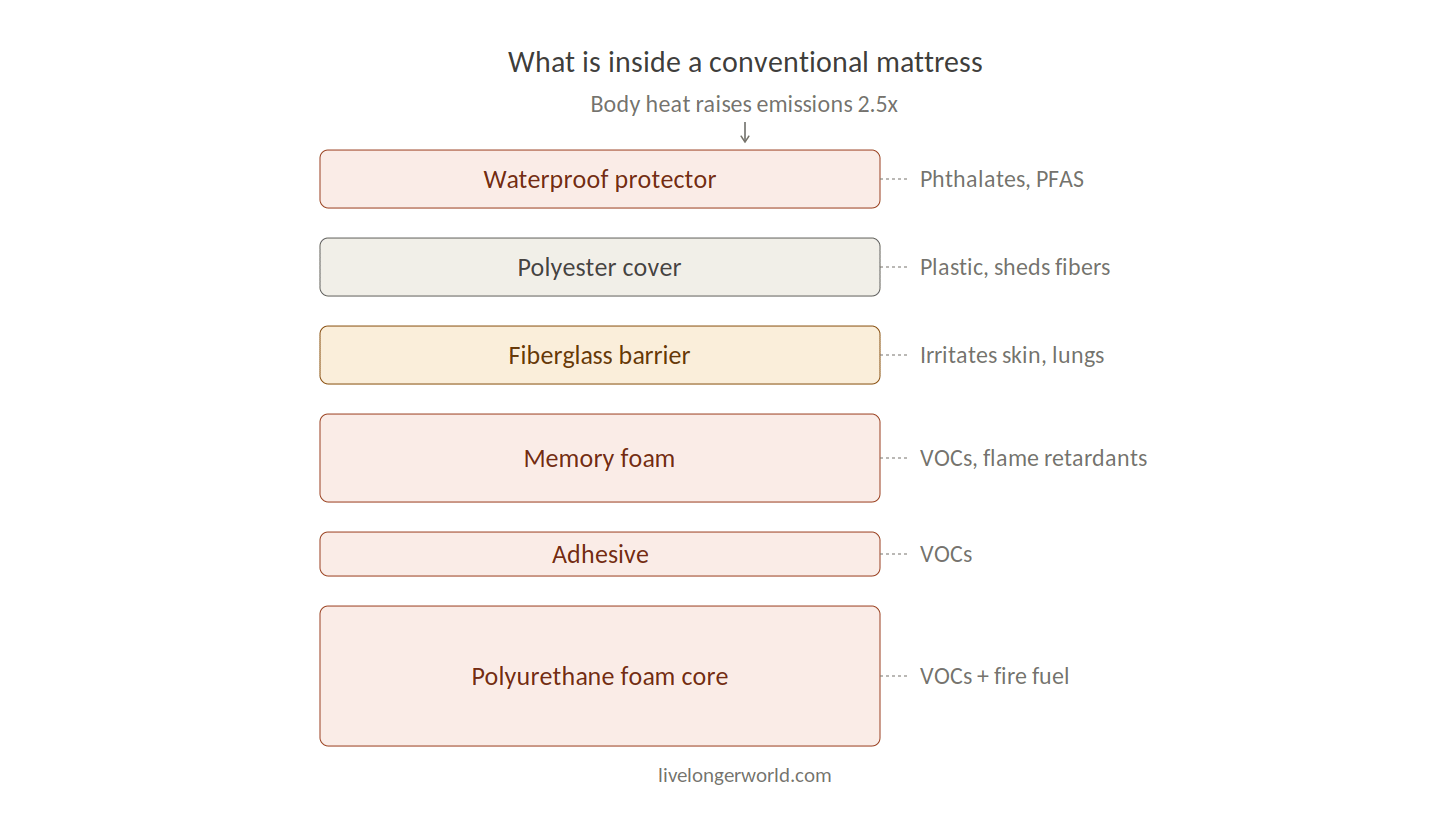
Foam mattresses also use knit polyester (plastic) on their covers. It gets worse where some waterproof mattresses covers and crib mattresses with vinyl have been tested for PFAS and phthalates, which as I said, are known endocrine disruptors.2
Fiberglass (spun glass) in mattresses also contributes to toxins. The fibers irritate skin, eyes and lungs. The bigger issue is when the cover gets unzipped or the fabric wears through, the fibers escape and spread through the whole house. There are households that have had to throw out clothing, furniture and carpet after this happened, and lawsuits to match. So much so that California has banned fiberglass in mattresses starting 2027.
What I Use Now
This is why I only use 100% organic mattress from Naturepedic and Happsy. They don’t use any polyurethane foam, adhesives, flame retardants, and fiberglass mentioned above. They are made with certified organic cotton, wool, and are GOTS-certified. Given my family and I sleep on it everyday for years to come, I don’t want to compromise on our mattress.
Why is a Mattress designed this way?
Before the 1950s and 60s, mattresses used to be made of cotton, wool, horsehair, and kapok. Then began the petroleum era and the rise of cheaper cost goods. Polyurethane foam (emit VOCs) used in mattresses today is a petroleum product, and it won on cost. It's cheap, it's light, you can tune it to any firmness, and it compresses small enough to ship in a box, which is why every bed-in-a-box company sells foam.
But the issue is this foam is also fuel. It’s a petroleum product, after all! So, it created fire risk for mattresses. In 2007, a federal rule started requiring every mattress sold in the U.S. to pass an open flame test. Manufacturers again chose the cheap route. They met the test by adding flame retardant chemicals to the foam. The very flame retardants that seem to lower IQ and were banned by California in 2020.
So what did the industry do after the ban? They moved to another bad solution from a health standpoint - wrapping the foam in a fiberglass barrier instead. California is banning that too, starting 2027. Let it be known that a mattress can pass the same fire test with a barrier that isn’t fiberglass and no added chemicals at all, but they don’t do it for cost reasons.
Even when fiberglass is banned, mattresses still have cheap materials like polyester, plus phthalates, PFAS and other SVOCs, which keep shedding toxins into your home over the life of the mattress.
Your Bedding is shedding plastic that you breathe in
The sheets that are the most cost effective and found in hotels are made of polyester. Polyester is plastic. You end up sleeping on a bed of plastic which sheds microplastics that you ingest through skin contact and breathing.
Polyester also traps heat so you sleep hotter which disrupts quality sleep. Sleeping cooler helps one sleep better. Further, polyester disrupts hormone health and fertility, increases inflammation, and might be contributing to heart disease.
This is why we sleep on 100% organic cotton sheets and pillow covers. Pact is my go-to for sheets.
I’ve written more on the harmful impacts of polyester and safer clothing options here:

Pillows too shed microplastics
Pillows share some of the issues with mattresses. They are filled with polyester and in memory foam pillows, it’s polyurethane foam. This means microplastic shedding and VOC emission. I use the Organic adjustable pillows from Naturepedic. It’s great that you can adjust the filling inside to make it the height you’d like.
Blanket / Comforter:
Similar to bedding, we only use organic natural materials for our comforter. We use a wool one from Coyuchi.
We spend many hours of our life sleeping, and it’s also the time when the body is repairing. I sincerely believe that we should maintain a non-toxic bedroom environment to allow proper rest and restoration.
In the next post, I’ll cover how I change our house and bedroom lighting, and EMF exposure at night.
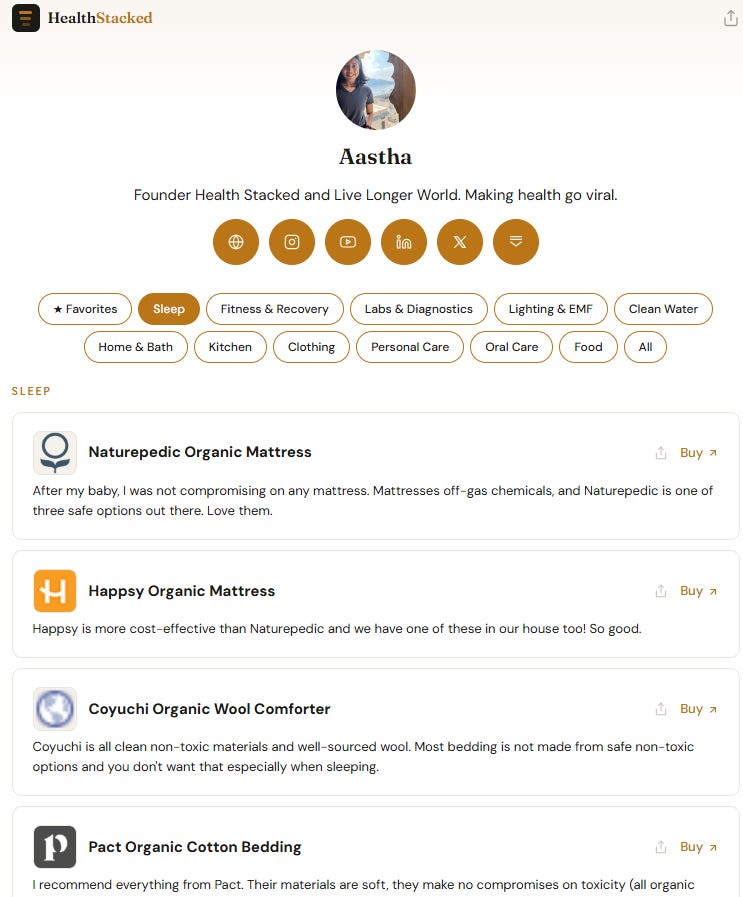
You can see all the sleep products we use at healthstacked.com/aasthajs3
Follow me on X @aasthajs & Instagram @aasthajs as I parse through the snake-oil in longevity. If my work is useful, become a premium subscriber.
Browse my health stack across 9 categories (sleep, fitness, non-toxic kitchen, skincare, diagnostics, lighting).
For the full collection of 300+ health products curated by me, see Health Stacked.
Recent Posts:


https://pubs.acs.org/esthag/article-abstract/48/6/3541/1481431/Infant-Exposure-to-Emissions-of-Volatile-Organic?redirectedFrom=fulltext
https://www.brandonboor.com/pdfs/ES&T_Letters.pdf
If you purchase any of the products using my links, it is a zero-cost way for you to support my work.