
Avoiding the sun kills more people than skin cancer
Sun avoidance is the new smoking. Landmark study breakdown.

Hi, I’m Aastha and thanks for joining Live Longer World as I parse through the snake-oil in longevity. On Health on Easy Mode, you can see my exact collection of non-toxic health products I use (15+ categories including clean water, lighting, air quality, non-toxic kitchen).
Dermatologists have spent decades telling us to avoid the sun. Wear sunscreen. Cover up. The fear is skin cancer. But one of the most thorough studies ever conducted on sun exposure and mortality found the opposite. Women who got the most sun lived the longest. Women who avoided the sun died at the same rate as smokers. And the most surprising finding of all? The women who lived the longest in the entire 20-year study1 got skin cancer AND were most sun-exposed.
And it wasn’t just about living longer. The study showed that women who got more sunlight were protected from:
Cardiovascular disease
Cancer (including skin cancer!)
Type 2 diabetes
Venous blood clots
Death from all causes
And the more the sun, the better the outcomes. In this post, I break down the study and what it means for how you think about the sun.
Basics of the study:
Researchers recruited 29,518 Swedish women between 25 and 64 years of age starting in 1990. They asked four simple questions about sun exposure:
Do you sunbathe during the summer?
Do you sunbathe during winter holidays?
Do you use tanning beds?
Do you go abroad on holiday to swim and sunbathe?
No to everything = low sun exposure. Yes to one or two = moderate. Yes to three or four = high. They also recorded smoking status, exercise habits, BMI, education level, marital status, disposable income, and whether the women were on medication for diabetes, blood clotting, or cardiovascular disease, all of which were used to adjust the results. Then they followed these women for 20 years and tracked what happened.
Results: Risk of disease & death increased by avoiding the sun
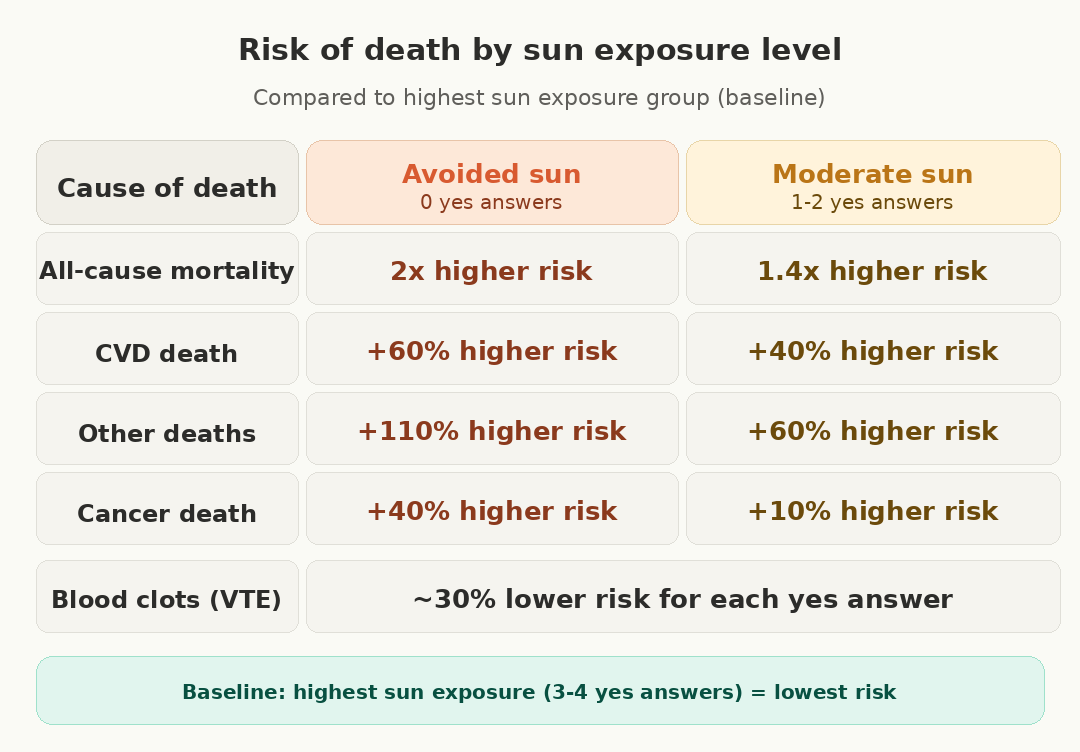
Not getting sun was as dangerous as smoking. Nonsmokers who avoided sun exposure had a life expectancy similar to smokers who got the most sun. Even among smokers, those around age 60 who actively sought the sun lived ~2 years longer than smokers who avoided it.
Heart disease: The highest sun exposure group had ~60% lower risk of cardiovascular death.
Cancer: The highest sun exposure group had ~40% lower risk of cancer death, including melanoma. In fact, women with the most sun exposure who developed non-melanoma skin cancer had the lowest mortality of anyone in the entire 20-year study. Lower than cancer-free women. Lower than every other group. More on skin cancer and melanoma findings below.
Melanoma: Melanoma incidence was slightly higher in the high sun exposure group (0.81% vs 1.1%), but the increase wasn't statistically significant. And when they did get melanoma, their risk of dying was essentially the same as sun avoiders who never got cancer at all. Meanwhile, sun avoiders who got melanoma had 4x the risk of death. And within the melanoma group specifically, sun avoiders had 8x the death rate of sun-seekers.
Diabetes: Women who avoided the sun were at nearly 2.5x the risk of type 2 diabetes compared to those with the highest sun exposure. The relationship was dose-dependent: moderate sun exposure carried 47% higher risk, and low sun exposure carried 147% higher risk. The effect was even more dramatic in normal-weight women, where sun avoiders had nearly 4x the diabetes risk.2
Other non-cancer deaths: The highest sun exposure group had over double (110%) the reduction in non-cancer, non-cardiovascular death (things like diabetes, multiple sclerosis, pulmonary diseases). Combined with the cardiovascular disease reduction, this is where the biggest increase in lifespan came from.
Dying from anything: Women who avoided the sun had double the risk of death over the next 20 years compared to those with the highest sun exposure. This translated to 0.6 to 2.1 fewer years of life for sun avoiders.
Blood clots: For every “yes” answer to sun exposure, women were at ~30% lower risk of venous thromboembolism. Blood clot risk was also 50% higher in winter compared to summer.
But is it really the sun? You might wonder: do sun-seekers just live longer because they're wealthier, more active, and healthier to begin with? The researchers tested this. They adjusted for age, smoking, education, marital status, income, pre-existing conditions, BMI and physical exercise. The results held. The survival benefit of sun exposure wasn't explained by lifestyle differences.
This study is not a one-off. A 2024 analysis3 of 376,000 UK Biobank participants found the same pattern: higher UV exposure was associated with lower all-cause, cardiovascular, and cancer mortality. A separate Swedish cohort study4 of women followed for three decades found sunbathing vacations were linked to 30% lower risk of death. The data pointing to sun exposure as protective against the leading causes of death is consistent across multiple large cohorts and countries.
But what about skin cancer risk?
Here's where it gets really counterintuitive. The women who lived the longest in the entire 20-year study weren't the ones who avoided skin cancer. They were the ones who got skin cancer and had the most sun exposure. They outlived everyone, including cancer-free women.
I couldn't believe this when I first saw it. For paid subscribers, I break down exactly what's going on:
How women with skin cancer outlived every other group in the study, including women who never got cancer.
The 8x death gap: why getting melanoma while avoiding the sun was the deadliest combination in the study, while getting melanoma with high sun exposure barely affected mortality.
The vitamin D connection: why the same cancer can kill one woman and barely affect another.
What no one tells you about the sun vs. skin cancer tradeoff: the risk of dying from skin cancer vs. the risk of dying from avoiding the sun.
The researchers sorted all 29,518 women into a grid, skin cancer status on one axis, sun exposure level on the other, and measured risk of death from anything.
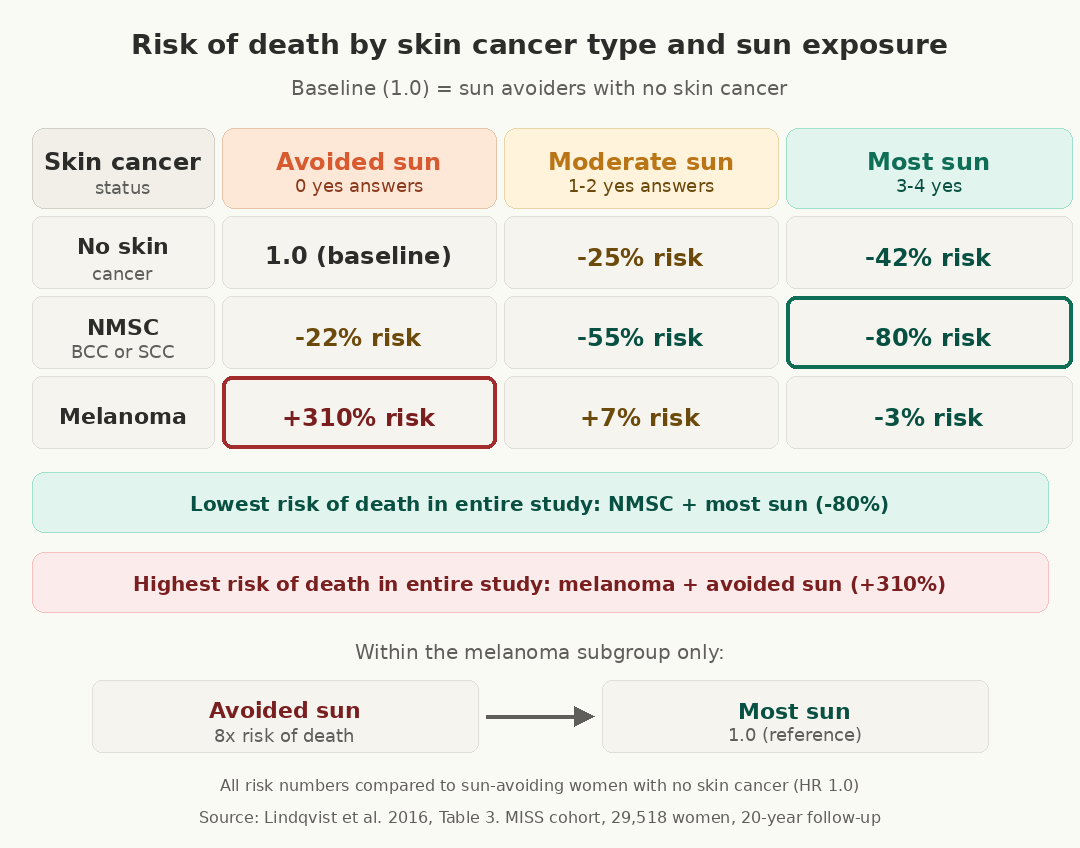
The results:
Longest-lived group: Women with the most sun who got non-melanoma skin cancer (NMSC) had 80% lower risk of death. This was the lowest of anyone in the entire 20-year study. They outlived everyone, including cancer-free women who got the most sun.
Most sun, no skin cancer: 42% lower risk of death vs. sun avoiders with no skin cancer.
Moderate sun + Non-melanoma skin cancer (NMSC): Lower risk of death than cancer-free women with the most sun!
Most sun + melanoma: Essentially the same risk of death as sun avoiders who never got skin cancer. Melanoma5 barely moved the needle.
Avoided sun + melanoma: The worst outcome of anyone. 4.1x risk of death risk compared to baseline. Within the melanoma subgroup, sun avoiders had 8x the death risk of sun-seekers.
This data perplexed me at first. I couldn’t understand how the longest lifespan was seen in women with most sun exposure + non-melanoma skin cancer. Or how moderate sun + getting non-melanoma skin cancer would have lower risk of death than most sun + no skin cancer. Here is how we can answer these questions, after I provide context.
Context on skin cancer:
Skin cancer comes in three types: basal cell carcinoma (BCC), squamous cell carcinoma (SCC), and melanoma. BCC and SCC are grouped together as non-melanoma skin cancer (NMSC). NMSC accounts for about 95% of all skin cancers but is almost never fatal. BCC in particular has a mortality rate that rounds to essentially zero. In the US in 2019, the mortality rate for BCC was 0 per 100,000 and for SCC it was 0.8 per 100,000. NMSC is so rarely lethal that most cancer registries in the US and Australia don't even record it. Globally, there were about 6.3 million NMSC cases in 2019 but only 56,000 deaths, a case fatality rate under 1%.
So when people worry about skin cancer, what they're really worried about is melanoma. Melanoma accounts for only about 5% of skin cancer cases but is responsible for the most skin cancer deaths, about 9,000 per year in the US. The five-year survival rate for melanoma caught early (localized) is over 99%. When it's spread to distant organs, that drops to 35%. Across all stages combined, the five-year survival rate in the US is about 95%.
Why did NMSC women outlive everyone?
As seen above, NMSC (basal cell carcinoma, squamous cell carcinoma) is almost never fatal. But developing it requires decades of cumulative UV exposure. The four yes/no questions in the study captured sunbathing habits at a single point in time. NMSC captures something the questionnaire can't - a biological record of total lifetime UV dose. Women who scored high on the questionnaire AND developed NMSC were likely heavy hitters of lifetime sun exposure, and they reaped the full cardiovascular and metabolic benefits. They got NMSC from high UV exposure, but they outlived everyone else due to the non-fatality of NMSC and the health benefits of the sun.
Previous studies6 found that people with basal cell carcinoma had higher rates of internal cancers and concluded sun exposure was dangerous. This study found the same numbers but the opposite interpretation: sun exposure keeps you alive longer, which gives you more years to be diagnosed with cancer. These women didn’t get more cancer because of sun. They lived long enough to get cancer instead of dying from a heart attack at 65.
This is backed up by independent data. A Danish study7 of over 72,000 BCC patients found that BCC patients had equal or slightly lower all-cause mortality compared to the general population.
What about moderate sun + NMSC?
The same logic applies. A woman who scored only 1-2 on the questionnaire but still developed NMSC probably had substantial sun exposure the questions didn't capture — decades of outdoor work, gardening, daily walking. These activities wouldn't register as "sunbathing" but still delivered enough cumulative UV over a lifetime to produce a skin lesion. NMSC is picking up real biological sun exposure that the questionnaire missed, which is why even moderate-scoring women with NMSC outperformed high-scoring women without it.
Why were the melanomas less aggressive in women with the most sun?
Women with the most sun who got melanoma had the same risk of death as sun avoiders who never got skin cancer. Among the women who got melanoma, sun avoiders had 8x the death risk of sun-seekers. What can explain this?
Vitamin D is the likely answer. A UK study8 of 872 melanoma patients found higher vitamin D at diagnosis meant thinner tumors and better survival. A follow-up9 with 2,000+ patients confirmed it. An Australian study10 found vitamin D deficiency at melanoma diagnosis was associated with a nearly 4x increase in risk of having a thicker tumor.
Weighing in on Sun Exposure benefits vs. Skin cancer risk
The takeaway here isn’t that you should go get skin cancer. And this data comes with caveats: it’s a single cohort of Swedish women at a northern latitude, and the results may look different for people with different skin types and UV environments.
But what the data does make clear is that the risks of sun avoidance are far greater than most people realize. Avoiding the sun to prevent skin cancer while doubling your risk of dying from cardiovascular disease, diabetes, and other causes is not a good trade. The women in this study who got the most sun lived the longest, even the ones who developed skin cancer along the way. And the women who avoided the sun didn’t just miss out on a tan. They died sooner, from nearly everything.
The current public health message treats sun exposure as a hazard to minimize. This data suggests the opposite: we benefit from greater sun exposure.
Aastha
Browse my Health on Easy Mode setup across 15+ categories (non-toxic kitchen, clean water, skincare, diagnostics, lighting).
Follow me on X @aasthajs & Instagram @aasthajs as I parse through the snake-oil in longevity.
Related:

https://onlinelibrary.wiley.com/doi/10.1111/joim.12496. The study was led by Pelle Lindqvist out of Karolinska University Hospital and published in the Journal of Internal Medicine in 2016. The VTE and diabetes findings come from earlier analyses of the same cohort. The melanoma incidence data comes from Lindqvist’s 2022 review in Anticancer Research.
https://pubmed.ncbi.nlm.nih.gov/39740826/
https://pubmed.ncbi.nlm.nih.gov/39094281/
https://pubmed.ncbi.nlm.nih.gov/21297041/
Melanoma incidence was slightly higher in the high sun exposure group (0.81% vs 1.1%), but the increase wasn’t statistically significant.
https://pubmed.ncbi.nlm.nih.gov/21788128/
https://medicaljournalssweden.se/actadv/article/view/7640
https://pubmed.ncbi.nlm.nih.gov/19770375/
https://pubmed.ncbi.nlm.nih.gov/25403087/
https://pubmed.ncbi.nlm.nih.gov/25970336/