

Why do we age? The standard answer is wear and tear, decades of damage adding up. But there's a stranger possibility: that aging begins the moment we finish growing up, because the goal that held all our cells together is suddenly complete. This is what Dr. Michael Levin is proposing.
Michael Levin is a researcher at Tufts University who has made massive contributions to the field of bioelectricity. He is one of the most fascinating thinkers working today, known for the radical idea that goal-seeking intelligence isn't unique to brains but operates at every level of biology, from cells to tissues to whole organisms. He draws on computer science, cybernetics, philosophy, and biology to see the body as a collective of problem-solving agents.
More recently, he has turned to the question of why we age. His theories bring a genuinely different perspective to the field, one that locates the cause of aging not in damage or genes, but in a loss of purpose at the cellular level. In this essay, I break down the theory he puts forth in a recent paper called Aging as a Loss of Goal-Directedness: An Evolutionary Simulation and Analysis Unifying Regeneration with Anatomical Rejuvenation.1
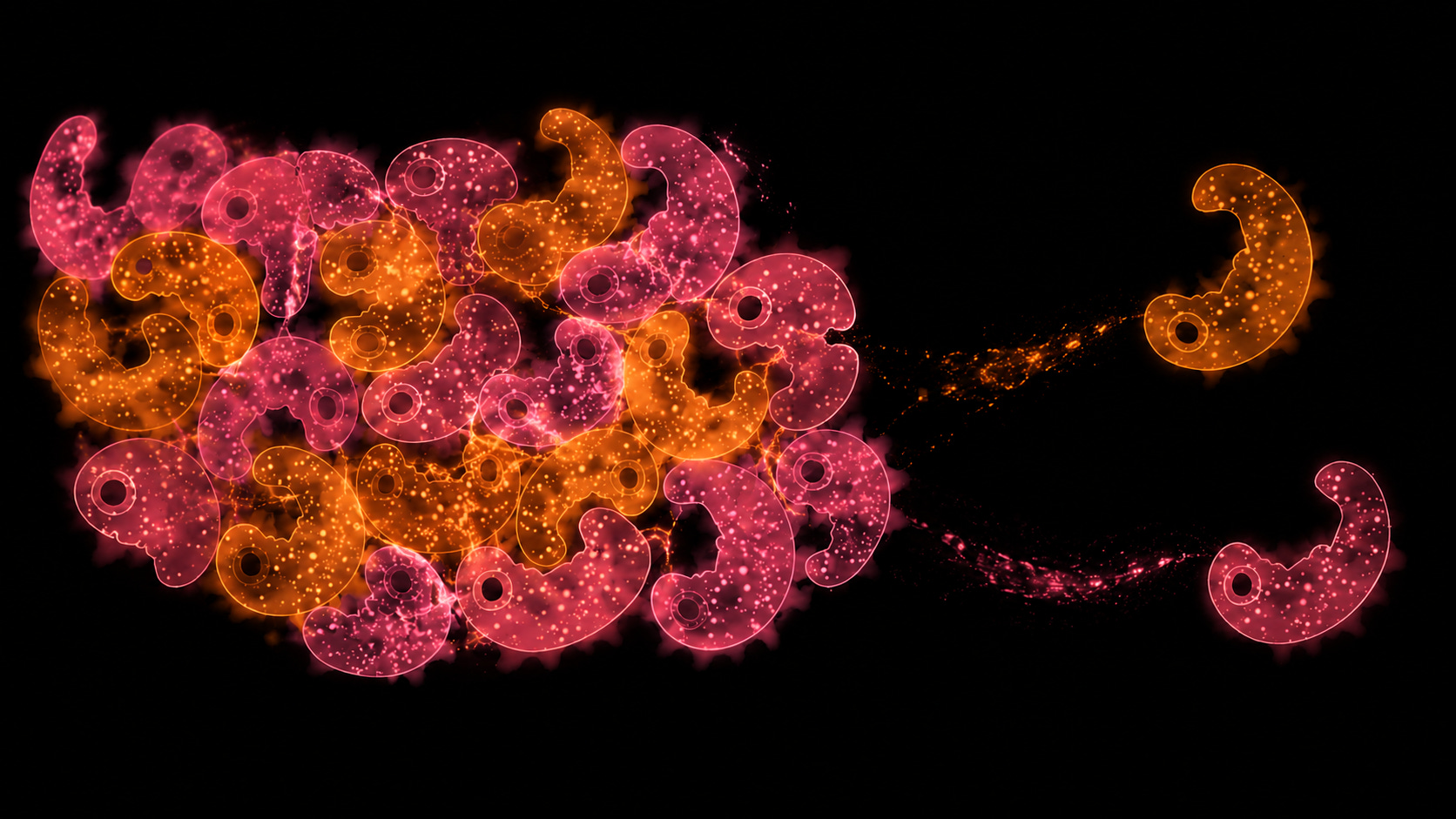
Development as a shared goal of the cellular collective
We all start life as a single cell. This single cell starts to rapidly divide. Groups of cells have to come together to produce organs, tissues, and body parts to give us the shape we eventually get. How do cells know how to construct a liver or a kidney or a heart? This question belongs to the area of morphology, meaning shape. In other words, how do cells know what shape to take on? We still don’t have good answers to this question.
What does seem clear is that morphology is a job that requires a group of cells or the “cellular collective” to work together. After all, for specific organs and body structures to take shape, it is a collective of cells that have to band together to do the work.
If you are in the camp that is comfortable with providing some agency to cells, you would say that cells possess the intelligence to come together and help in our development - to go from single cell to embryo to baby to toddler to teenager to adult. During this entire growth phase, the collective of cells come together to accomplish the common goal of development. In order to do so, they exchange information using biochemical, biophysical, bioelectrical and other signals. These signals are information exchanged between cells to collaborate smoothly in our development.
Let’s go with the analogy of a basketball team whose shared mission is to win the NBA. The players come together and exchange information through language, gestures, and other signals to move towards their goal of winning the NBA. Our cells too have languages they use to accomplish their shared goal of development.
What happens when cells have completed their goal of development, aka we are fully developed adults? What binds these cells together once the goal of the cellular collective is accomplished? Do cells now begin to disband? Is this where aging begins? Once the basketball team has won the NBA, do some players start to disband? Some consider leaving the team for a new one. Does this begin the degeneration process?
Mike Levin’s radical new theory of aging
Michael Levin’s new theory proposes that aging begins once cells have achieved their common goal of development. Without this shared goal, they no longer have a higher guiding goal to band together. You start to see degeneration and loss of information sharing between cells, manifesting as aging.
After cells have completed development, there is “informational dead end of completing one’s mission and not having a new setpoint toward which to strive.”
“primary new proposal here is that complex goal-driven systems can experience a kind of intrinsic disorganization after they have met their goal. In the absence of strong effort toward targets in morphospace, the cellular collective begins to disband, giving way to systemic disease states such as degeneration and cancer the inevitable outcome of a body that increasingly becomes a group of individual cells, not a unified higher-order morphogenetic agent.”
The problem is that post development, the main job of cells is maintenance and repair. However, Levin says that evolution taught cells to develop, but didn’t teach cells to be good at maintenance.
“organisms learned during evolution with development as the primary goal; once they reached that goal, we observed that they don't regenerate by themselves and slowly show signs of morphological deterioration, e.g., aging. In this sense, aging can be seen primarily as a loss of goal-directedness, the goal of development being different from the goal of maintenance of the anatomy over timescales exceeding development.”
My question to Mike is: why would evolution not teach skills to be good at maintenance?
Levin’s theory explains why self-regenerating animals don’t age
This theory also explains why organisms like planaria that are constantly in growth or regeneration mode have very long lifespans. Because if you are constantly growing, cells always have a shared developmental goal to strive towards. The process of disbanding and going your own way (aging) doesn’t occur much.
“Our model predicts that indeterminate growth patterns (or regeneration) should correlate with minimal aging phenotypes, as persistent morphogenetic goals would prevent the loss of anatomical homeostasis goal that characterizes aging. This aligns with observations of negligible senescence and extreme longevity in species like lobsters, certain sharks, planaria for continuous regeneration, and some trees and fungi that maintain continuous growth throughout their lifespans.”
But don’t we have regeneration and repair as well?
Levin argues that post development, while we do have regeneration at the local tissue level, there is no higher order mission of developing the embryo that bands ALL the cells together. When we’re an embryo we strive towards the global goal of building the organism. Post development, the global goal is complete. Yes, cells still have local goals of tissue regeneration at the local level, but what is binding the entire organism together? What is the goal of ALL the cells that brings them together?
After development, there's a void at the top. No mission. No shared goal. Just cells doing their individual jobs, slowly drifting apart.
Multi-competency architecture: Your body solves problems at every scale
Understanding Mike Levin’s concept of “multi-competency architecture” will add to the explanation. Multi-competency architecture is Levin's term for the fact that your body solves problems at every scale. Molecules fix molecular problems. Cells fix cell problems. Tissues fix tissue problems. Organs fix organ problems. During development, all these scales are aligned toward one shared mission: build the body. After development, each scale keeps doing its local job, but there's no longer a mission uniting them all.
“Another important aspect of biology, so far neglected in the models of aging is multiscale competency. Biological systems implement an architecture in which context-sensitive problem-solving operates across various levels, from molecular networks to individual cells, tissues, organs, organisms, and even collective groups such as swarms. This structure allows biological entities to solve problems within specific domains and problem spaces relevant to each scale (metabolic, physiological, anatomical, and behavioral state spaces), contributing to the overall adaptability and resilience of life.”
This theory argues that current aging theories neglect the idea of multi-scale architecture which is critical to understand cellular goals. Post development, while cells may maintain regenerative goals at the local level for a while, there is no shared mission that unites them across local scales at the organismal scale.
In-silico simulation
Mike Levin’s lab built a computer simulation to test this theory. They created virtual organisms made of cells on a grid. Each cell has a tiny neural network, think of it as the cell’s brain, that reads the states of its neighboring cells and decides what to do. Every cell shares the same “DNA” (the same neural network weights), just like every cell in your body shares the same genome. But each cell behaves differently because it’s reading different neighbors.
They used an evolutionary algorithm to train these virtual organisms to grow a smiley face pattern from scratch, purely through local cell-to-cell communication. No central controller. No master blueprint. Cells just talk to their neighbors and self-assemble the pattern. Think of it as a simulation of embryonic development.
Once the smiley face was fully built, they let the simulation keep running. The cells kept doing their thing, reading neighbors, updating states, but there was no longer a goal to work toward. Development was complete.
The smiley face slowly fell apart. Eyes blurred. The mouth distorted. Features disappeared. And this happened with zero damage introduced. No genetic mutations. No cellular noise. No external stress. The morphological decline was purely a consequence of the system running past its developmental goal. Aging emerged on its own.
They then tested whether adding damage, things like communication errors between cells, genetic corruption, or reduced cellular competency, would accelerate the decline. It did. All of these made aging worse. But none of them caused it. Even with perfectly functioning cells, aging still happened. In their model, the damage we associate with aging were accelerants, not the root cause.
In my mind, this is the most surprising implication. Most of us tend to think of aging as damage accumulation. But in Mike’s model, aging happens whether there is a damage or not. The damage merely accelerates aging.
Do we all have dormant regenerative potential?
Maybe the most surprising finding from the simulation: even after an organ completely disappeared from the virtual organism, the surrounding tissue still carried a memory of where that organ used to be. The spatial information persisted, like a ghost of the lost structure encoded in the neighboring cells.
This means the blueprint doesn’t vanish when the structure degrades. It goes dormant.
And in biology, we see hints of this. Salamanders regrow entire limbs. Planaria regenerate whole bodies from tiny fragments. The information to rebuild is clearly stored somewhere in the tissue. Levin’s model suggests that humans might retain similar latent information. We just lack the signals to reactivate it.
The cells already have the construction manual. They ran it once during embryonic development. The program is still in the DNA. What’s missing isn’t the instructions. It’s the trigger to re-execute them. My question to Mike: Why don’t we have this trigger?
Going back to the basketball analogy. The players who won the championship are still elite athletes. They still know how to play. They’re just sitting at home without a game to play.
What does this mean for regenerative therapies?
The simulation also tested different strategies for restoring lost organs. The most effective approach wasn’t telling individual cells what to become. It was providing contextual information, the correct relationship between a cell and its neighbors.
This makes sense when you think about how development works. A cell doesn’t know it should be a liver cell in isolation. It knows it should be a certain type given what its neighbors are doing. Development is a relational program. So regeneration needs tissue-level and relational signals.2
In the simulation, resetting damaged cells to an early developmental state and letting them re-read their neighbors was far more effective than forcing cells into a specific identity. You’re not rebuilding the organ. You’re recreating the conditions under which the organ originally built itself.
This is exactly what Levin’s experimental bioelectricity work is exploring outside of this simulation. Cells communicate through voltage gradients, electrical signals that encode tissue-level patterns. His lab has already shown that manipulating these bioelectric patterns in frogs can induce eye formation in places eyes don’t normally grow. The cells had the program to build an eye all along. They just needed the right contextual signal.
The implication for anti-aging: instead of chasing individual types of molecular damage, senescent cells, oxidative stress, telomere shortening, the deeper lever might be restoring the tissue-level signaling patterns that give cells a shared goal. Not fixing the parts, but restoring the mission.
One way to put it is that aging begins once cells complete their mission of development. So what if we could reverse aging by restoring a common mission?
Regenerative medicine is about getting the band back together and giving them a new season.
Follow me on X @aasthajs & Instagram @aasthajs as I parse through the snake-oil in longevity. If my work is useful, become a premium subscriber.
Browse my health stack across 12+ categories (sleep, fitness, non-toxic kitchen, clean water, skincare, diagnostics, lighting).
For the full collection of 500+ health products curated by me, see Health Stacked.
Related Posts:


Mike has recently written another aging theory called Atavistic Genetic Expression Dissociation (AGED) During Aging which I do not discuss here.
A tissue-level signaling pattern is the full map of these signals across a region of tissue, the complete voltage and chemical landscape that tells every cell where it is and what it should be. If a relational signal is what one cell reads, the tissue-level pattern is the entire picture spread across all of them. Levin’s bet is that this pattern, not the DNA inside any single cell, is where the body’s anatomical blueprint is actually stored.
Consider that regeneration occurs continuously as ‘turnover’. Levin has referenced Peter Reddien’s “The Purpose and Ubiquity of Turnover”. Isn’t aging the mismatching of turnover rates within the complex constituencies of cells? Too much of one and not enough of another, the former strains mechanisms for disposal while the latter slows replenishments? Mechanical forces can train resilience into the cognitive glue (bioelectricity).
Interesting to look at it from a purely psychological point of view: one of the most consistent and well replicated findings is that people in their 70s and beyond age more slowly when they have a strong sense of purpose. This appears to have direct effects at a cellular level.